

NNCI Image Contest 2026 - Stunning
Most Stunning
This category celebrates the beauty of the micro and nanoscale. Please check out the images below and read a little about the research behind them.
Vote Here
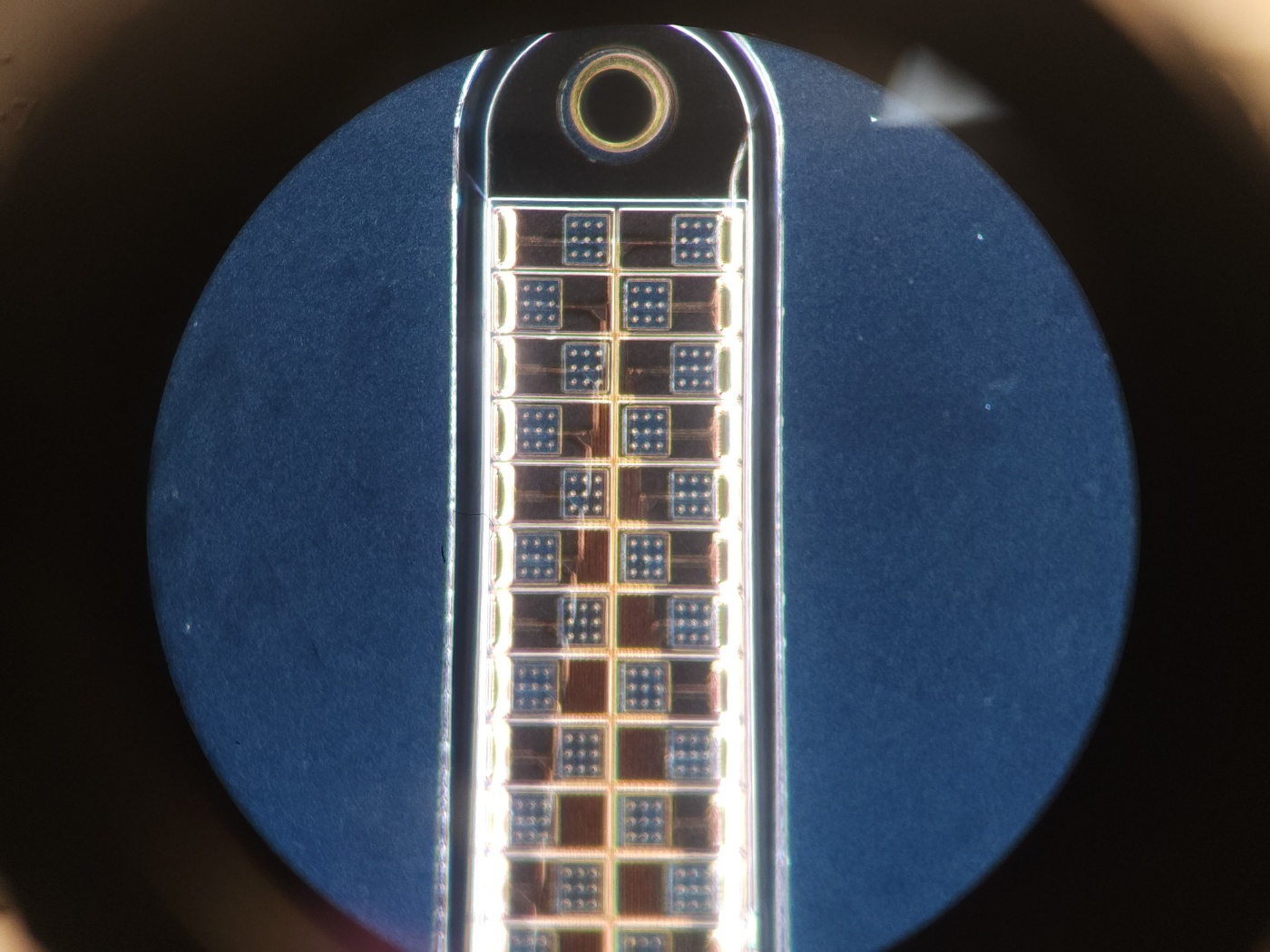
Microfabricated Neuropixel
Artists: Jaehyo Park (Grad Student), Dr. Azahara Oliva, and Dr. Antonio Fernandez-Ruiz, Cornell University
NNCI Site: CNF
Tool: Nikon L200 Eclipse Microscope (polarized dark-field mode)
High-Density Polymer Thin-Film Brain Probe: Inspection of the Multilayer Stack by polarized dark-field microscope.
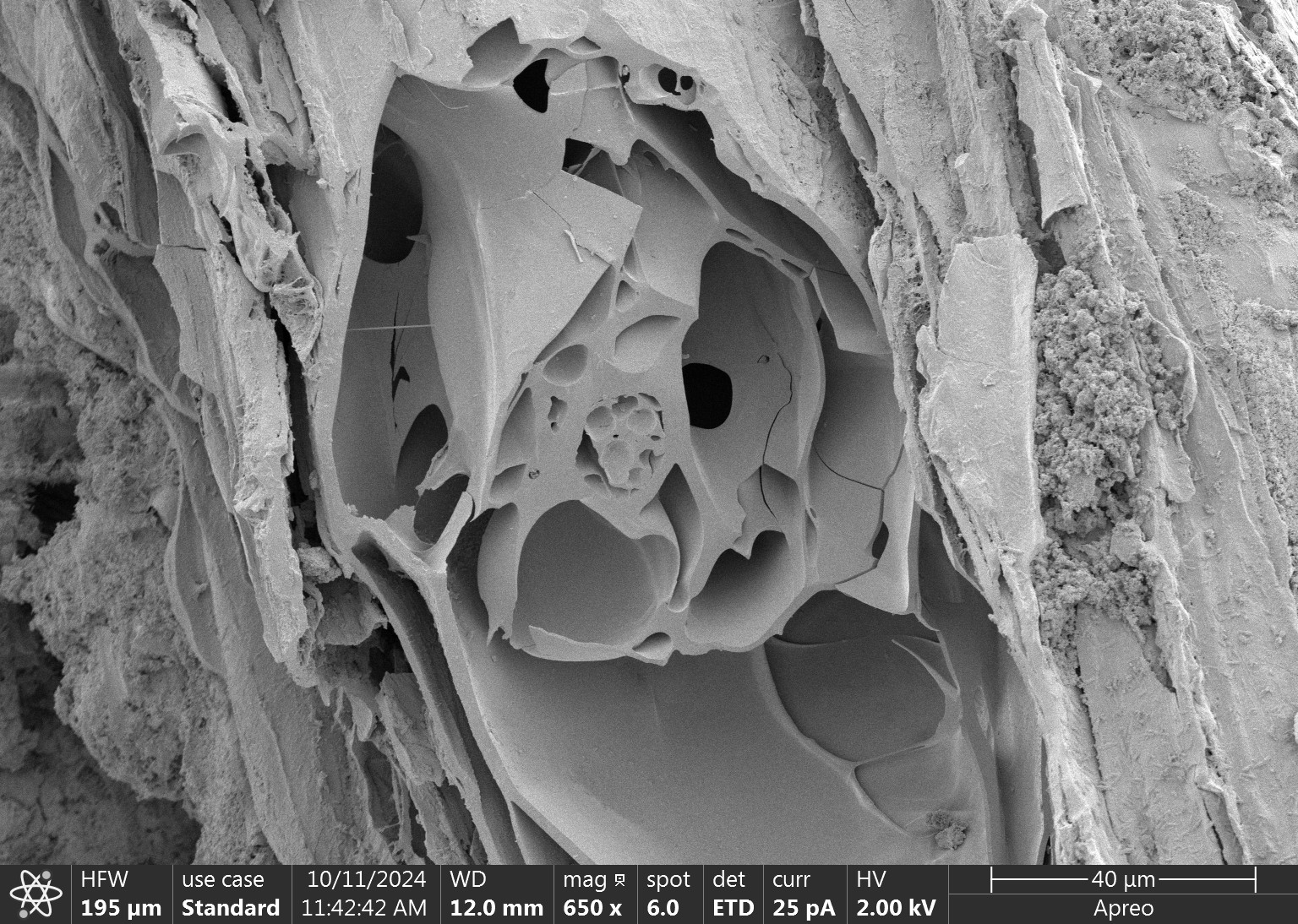
The Hidden Architecture of Biochar
Artist: Junead Mankari, PhD Candidate, University of Louisville
NNCI Site: KY Multiscale
Tool: SEM - MNTC's Huson Lab (UofL)
Beneath its seemingly simple surface, biochar contains a complex network of pores and channels that define its unique structure and functionality. This SEM image reveals the layers of internal architecture of the biochar, resembling a hidden landscape of interconnected cavities. These pores provide a large surface area and can facilitate water retention, adsorption, and interaction with surrounding materials. The image highlights how a naturally derived material can possess an engineered-looking architecture at a scale invisible to the naked eye.
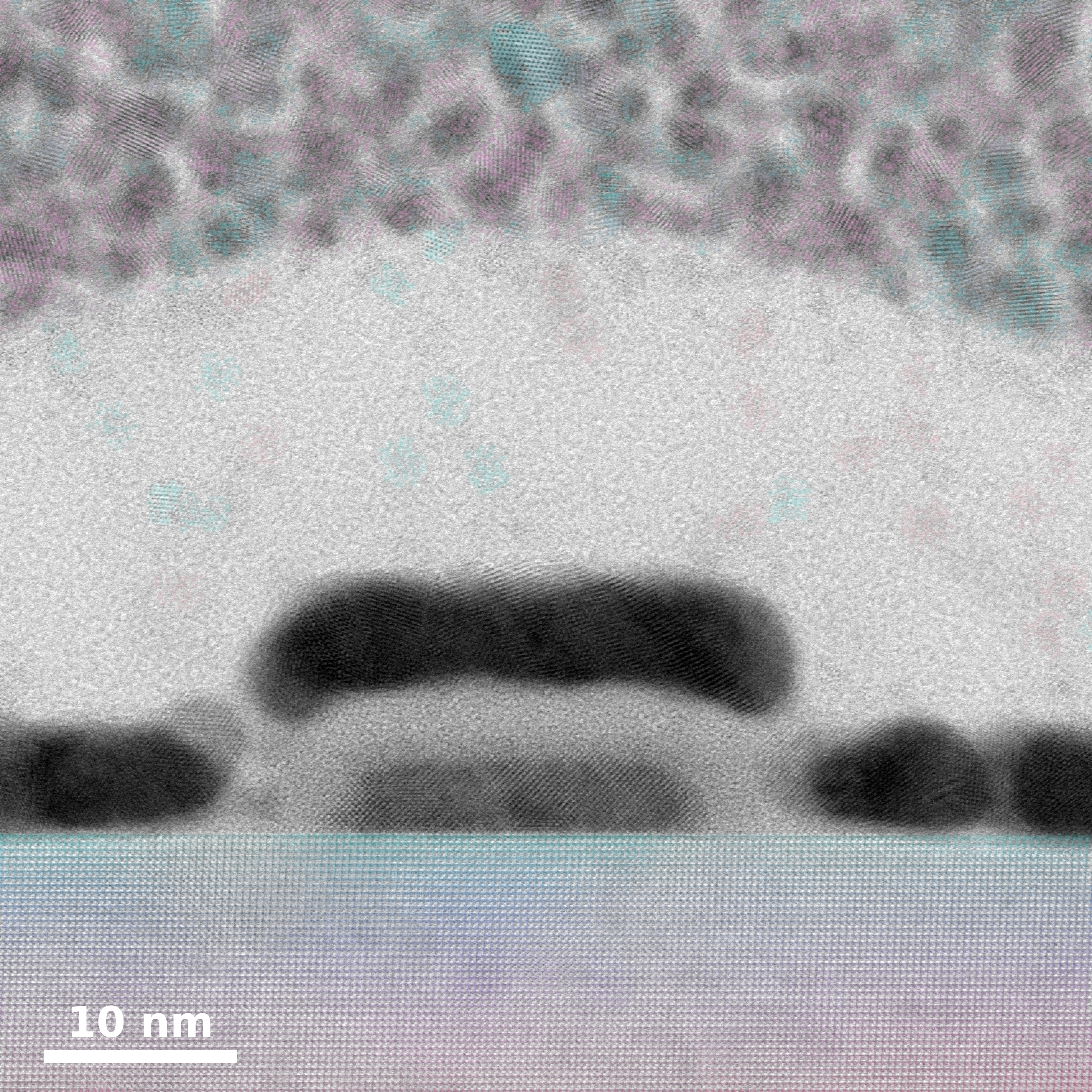
Nanoribbon at Twilight
Artists: Ashildur Fridriksdottir (Ph.D. student) & Andrew Barnum (TEM Scientist), Stanford University
NNCI Site: nano@stanford
Tool: Thermo Fisher Scientific Spectra 300
This bright-field cross-sectional STEM image shows a single niobium phosphide (NbP) nanoribbon grown on an epitaxial niobium seed layer on a sapphire substrate. False color traces the atomic columns of the sapphire lattice and highlights the platinum nanocrystals above according to their crystal orientation. This topological semimetal nanostructure demonstrates ultra-low resistivity, surpassing all known metals and semimetals at comparable dimensions, addressing a key bottleneck for interconnects in hyperscaled nanoelectronics.
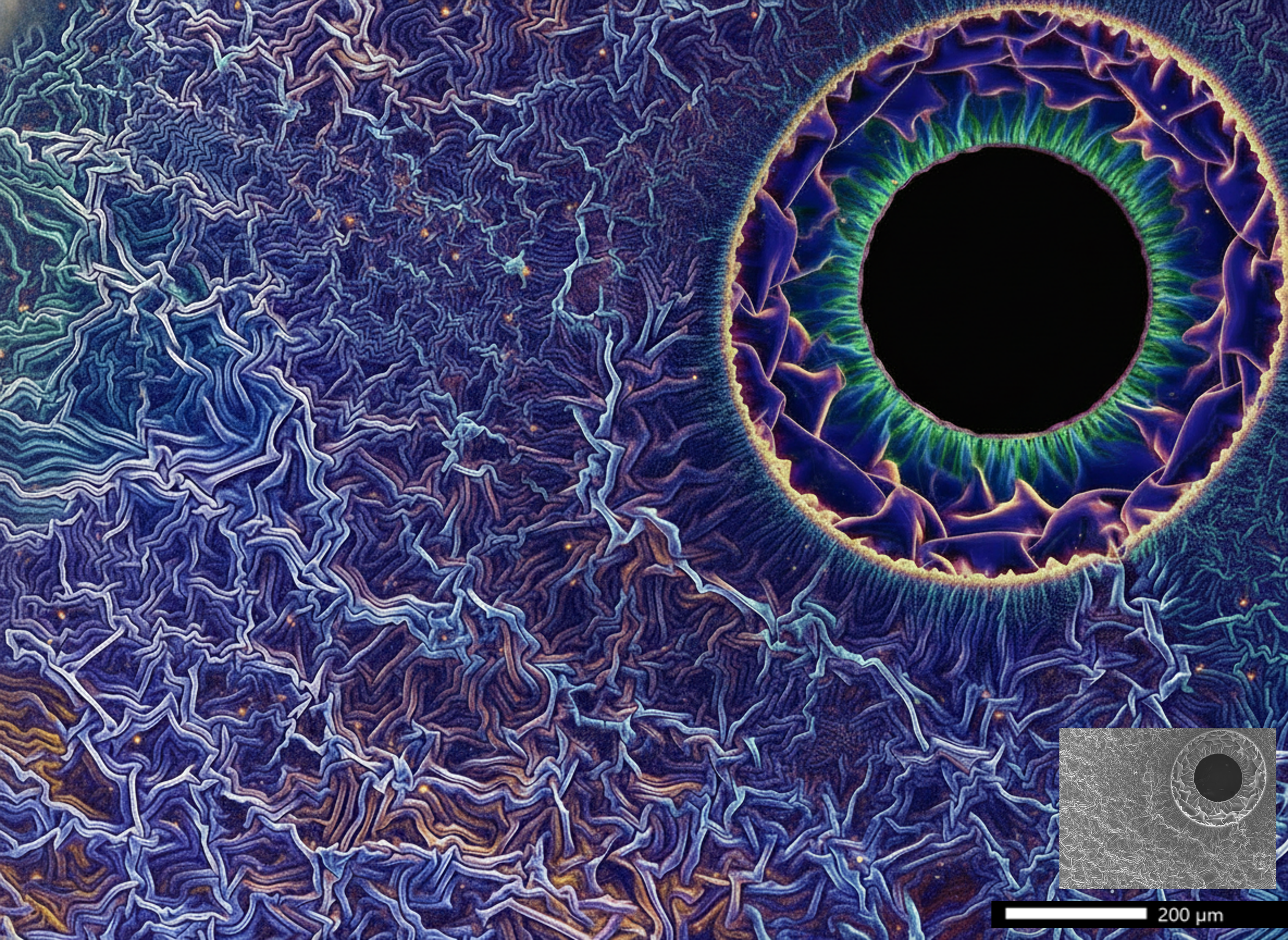
Black Hole in Multimaterials Universe
Artist: Zahra Bahranifard, Graduate Student, Virginia Tech
NNCI Site: NanoEarth
Tool: JEOL JSM IT-500HR
Short Description (100 words): SEM micrograph showing the surface morphology of a multi material used printed scaffold for biomedical applications. Due to the differing physicochemical properties of the constituent materials, a Turing like pattern emerges, producing intricate, interconnected wavy structures across the surface. The observed hole is attributed to the presence of an entrapped air bubble during the printing process.
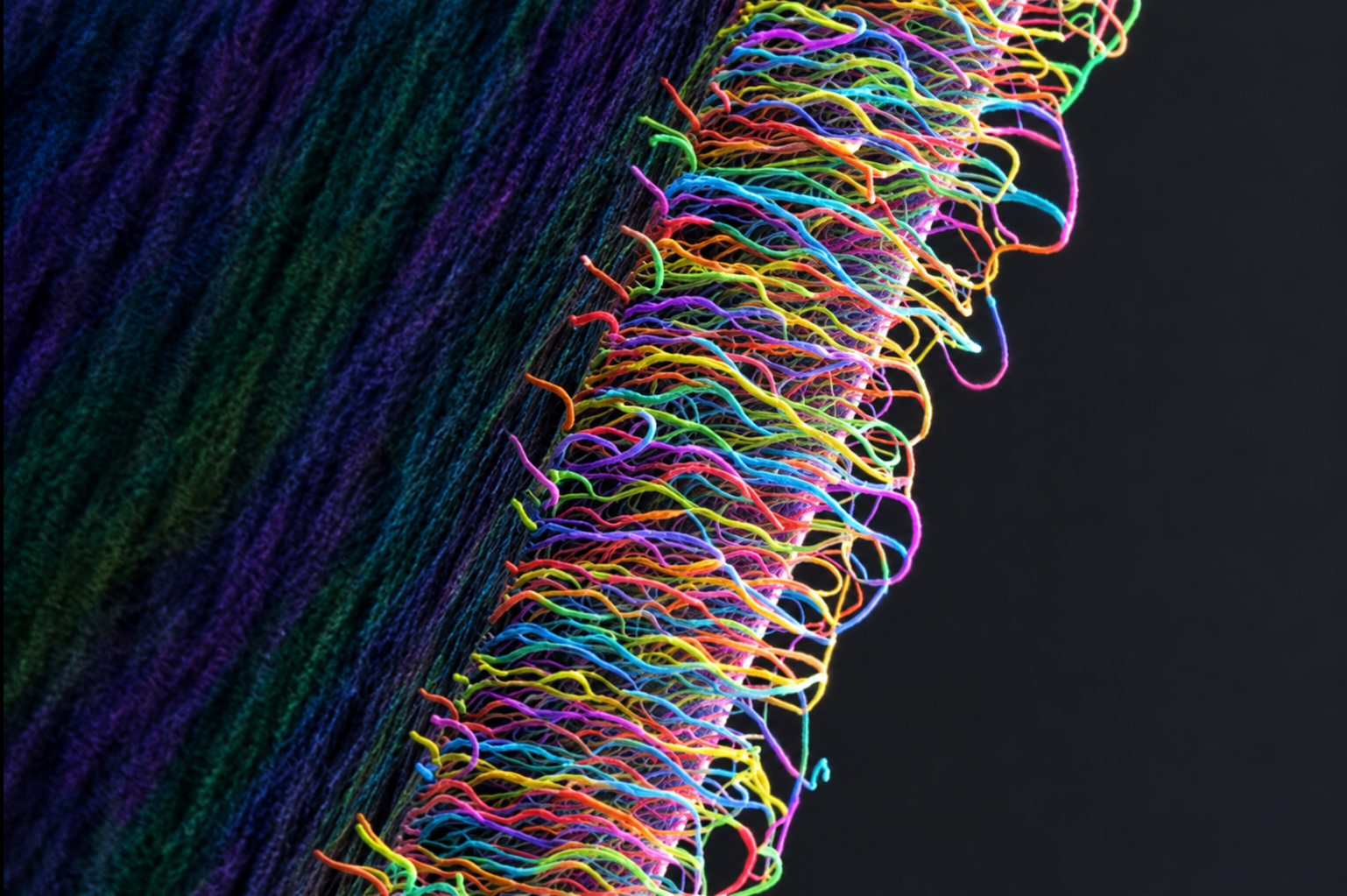
Carbon Nanotube Rainbow
Artists: Nicole Iverson (Associate Professor) & Omar Sadak (Post Doctorate Scholar), University of Nebraska
NNCI Site: NNF
Tool: SEM
Single walled carbon nanotubes were aligned on a glass slide before it was broken down the middle and imaged. This image is pseudocolored to show each of the different nanotubes in its own spectacular color.
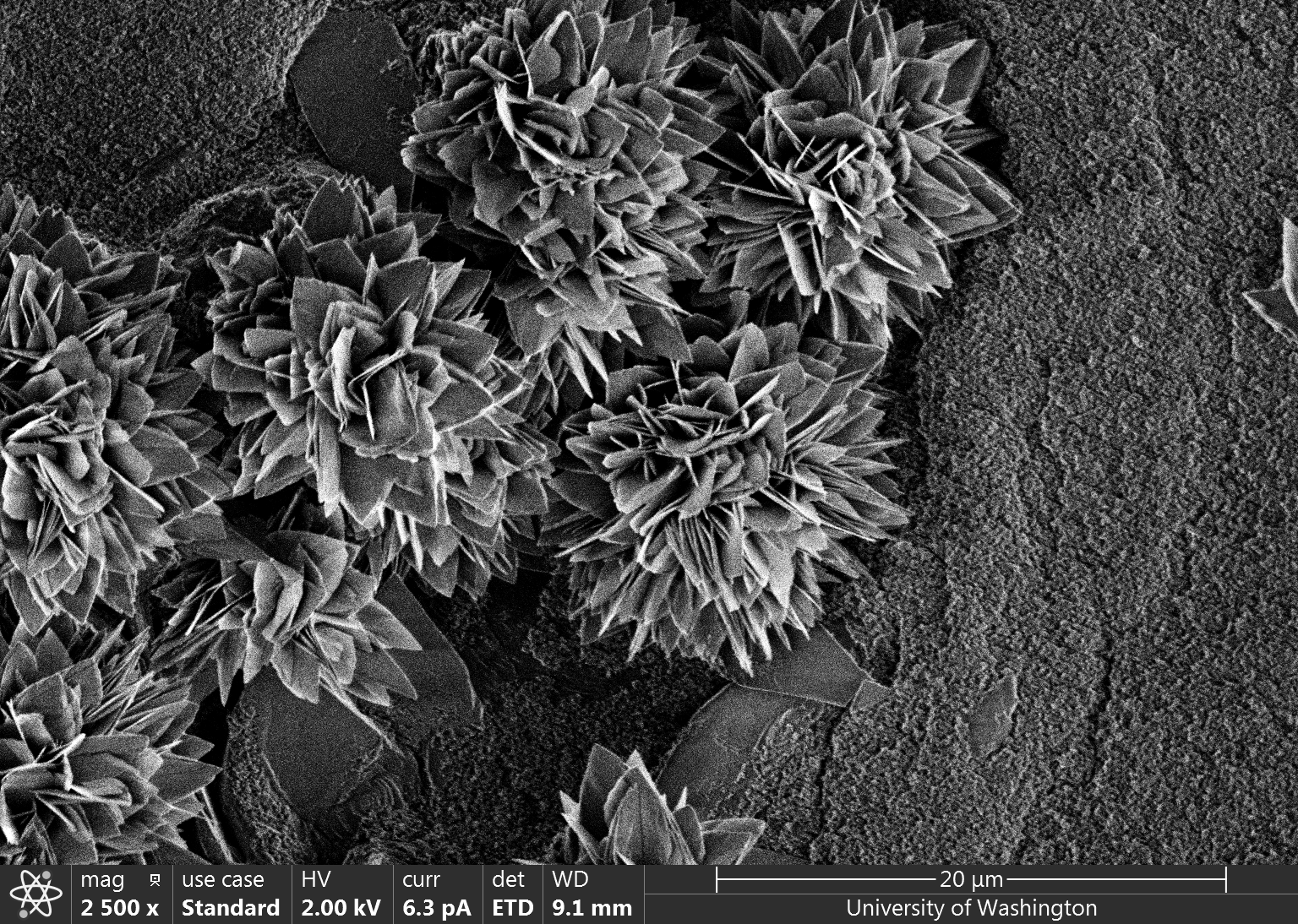
Phosphate Phlowers
Artists: Joelle Scott, Graduate Student, University of Washington
NNCI Site: NNI
Tool: ThermoFisher Scientific Apreo S SEM
This image shows cobalt/nickel phosphate crystals embedded in a (dried) hydrogel. The research behind this involves critical material recovery and selective separation from water. Utilizing the restrictive space of a polymeric hydrogel, a feed of cobalt and nickel salts are allowed to diffuse into the hydrogel and react with a phosphate counterion found in the gel. Based on the reaction-diffusion properties of this process, the cobalt and nickel form phosphate precipitates at different ratios along the length of the gel
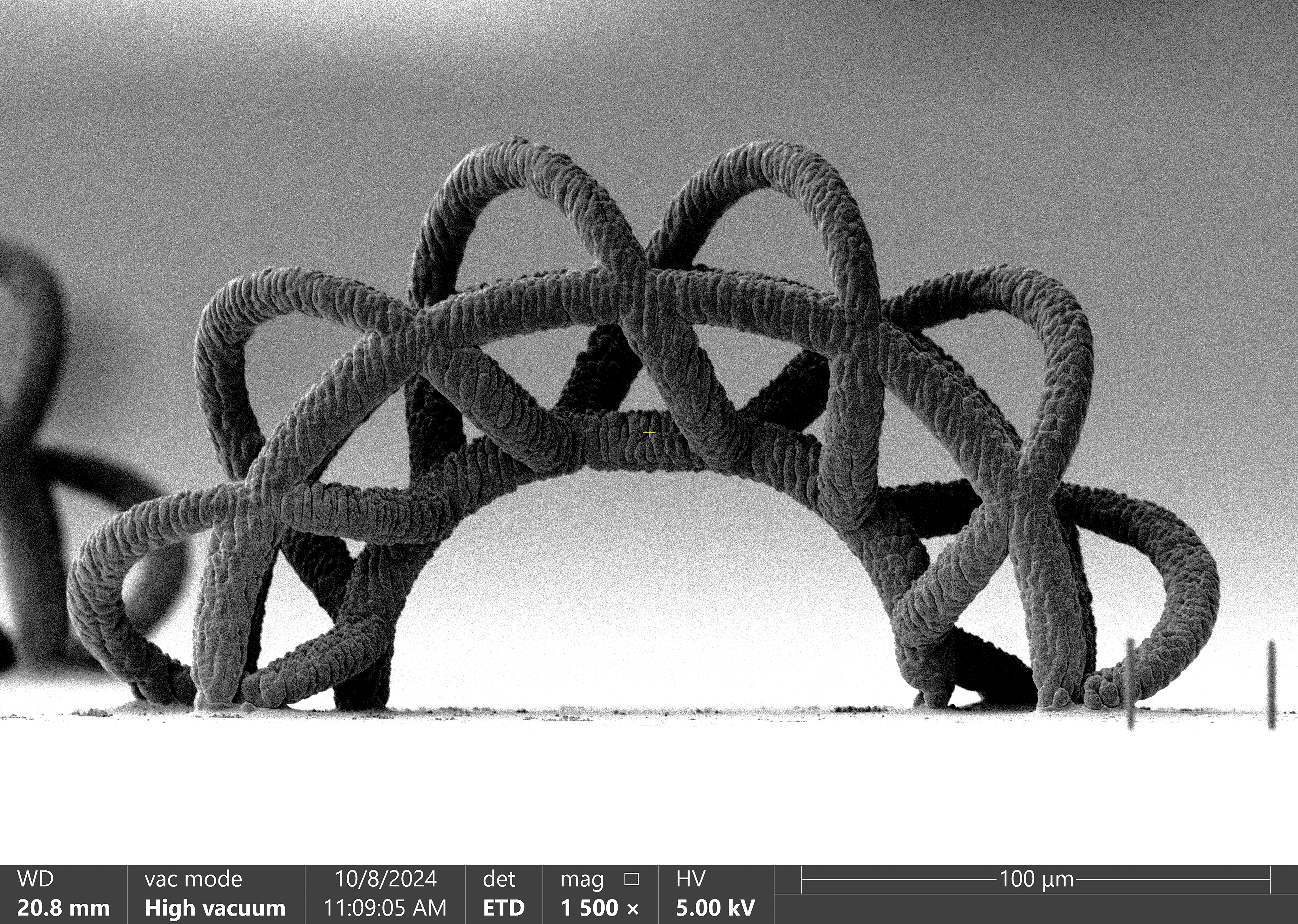
The Lake Monster
Artists: Genaro Soto Valle Angulo, Graduate Student, Georgia Institute of Technology
NNCI Site: SENIC
Tool: Image taken on Thermo Axia SEN, structures printed on Exaddon Metal 3D Printer
The structures on the image were printed with the Exaddon Metal 3D Printer, out of pure copper with the substrate being a Si wafer coated with a seed layer of copper.
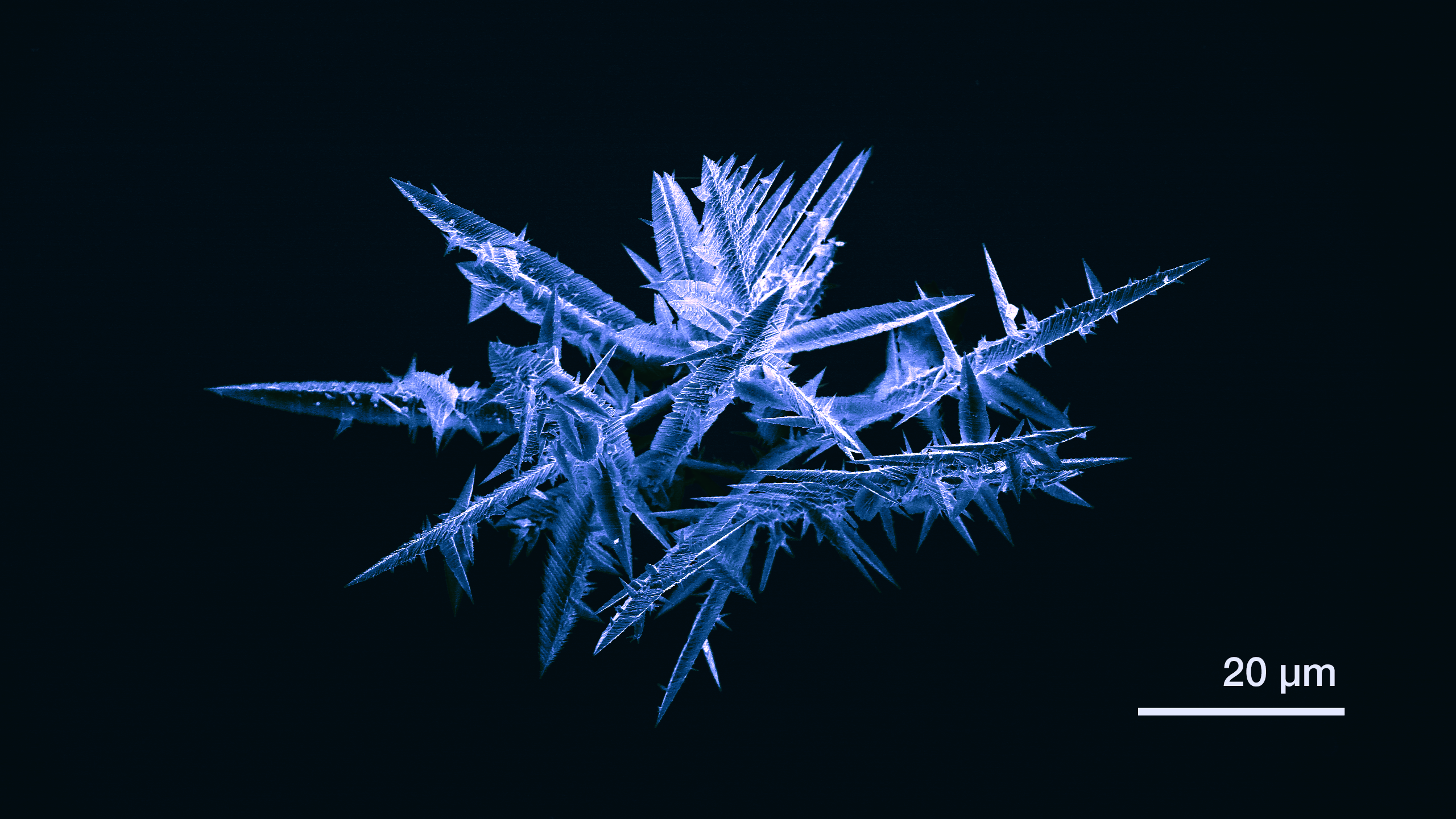
Into the µnknown
Artist: Luis Fernando Ayala, Graduate Student, Kelley Lab, Northwestern University
NNCI Site: Northwestern University-NUANCE Center
Tool: Hitachi SU8030 SEM
What looks like an ice crystal from Elsa’s palace is actually a gold nanostructured microelectrode used for electrochemical sensing. An applied potential reduces gold ions from an aqueous gold chloride solution, producing sharp features that grow outward from the electrode surface.